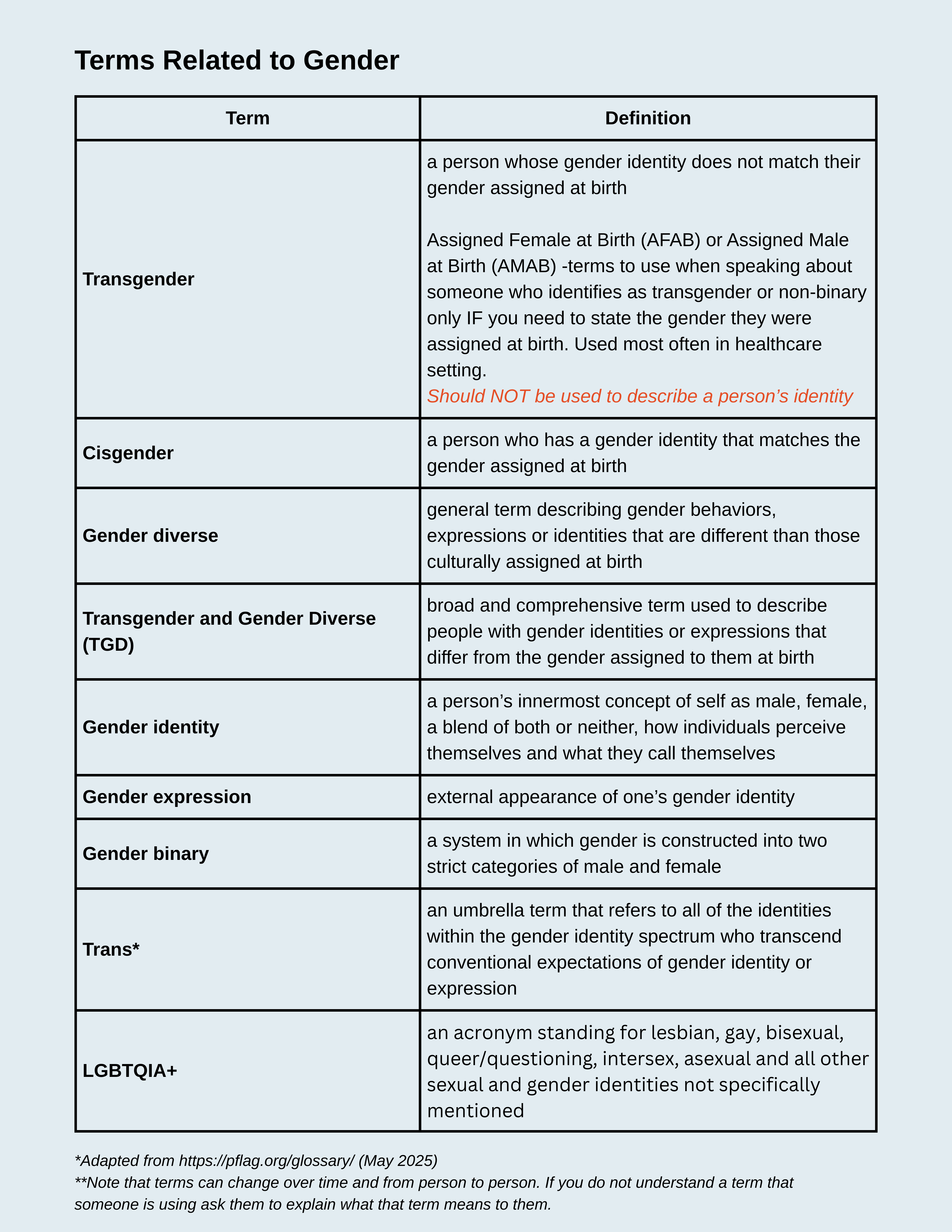
As advocates for children and youth in healthcare, child life specialists who work in the United States should be aware of gender-affirming healthcare laws that may impact the patients and families that we serve. While this resource is specific to the United States, it is recommended that child life professionals in other countries remain aware of the healthcare laws related to gender-affirming care in their countries as well. There are approximately 300,000 youth between the ages of 13 and 17 who identify as transgender in the United States (Herman et al., 2022). Many youths who identify as transgender experience gender dysphoria, which is a term used to describe a marked incongruence between one’s experienced or expressed gender and the gender they were assigned at birth. According to the DSM-5-TR, gender dysphoria should have a duration of 6 months or more prior to diagnosis (American Psychiatric Association, 2022).
Many people with gender dysphoria or distress related to gender seek gender-affirming healthcare, which includes both medical and non-medical interventions. Non-medical interventions are considered social transition, and may include choice of name, pronouns, clothing and hairstyle that correspond with the youth’s identified gender. Medical interventions for youth may include puberty blockers to suppress pubertal body changes for the assigned birth gender and the provision of hormones to promote gender-affirming puberty (The Trevor Project, 2020). All major medical associations support gender-affirming care, including the American Academy of Pediatrics, the American Psychological Association, and the American Academy of Child and Adolescent Psychiatry (Logan, 2024).
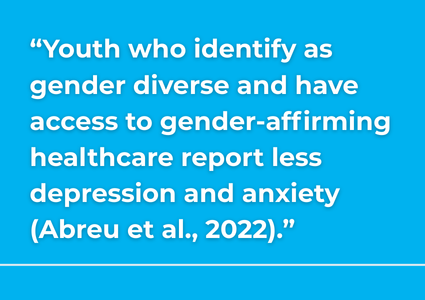
Research has shown that youth who identify as transgender or gender diverse experience more mental health concerns, including depression, anxiety, suicidal ideation and self-harm than their cisgender peers. On the other hand, youth who identify as gender diverse and have access to gender-affirming healthcare report less depression and anxiety (Abreu et al., 2022). Parents or caregivers have expressed concern for the mental health of youth who identify as gender diverse if they are denied gender-affirming healthcare. In a study conducted by Abreu et al. (2022), the parent of a 10-year-old child who is gender-nonconforming stated, “By denying gender-affirming healthcare to transgender youth, you are directly responsible for the increase in suicide attempts and completions.” Furthermore, the parent of a 17-year-old transmasculine teenager discussed the effects of her parental rights being taken away by the passage of one of these laws: “By removing my right to provide him with medical services that help resolve the dysphoria, he has now begun struggling again with his eating disorder” (Abreu et al., 2022). Medical providers have expressed worry about the mental and physical health of youth who identify as gender diverse if denied access to gender-affirming care. One provider from Massachusetts stated, “I fear it would lead to increased suicide attempts and completed suicides as well as a search for illegal means of getting the medications which are a normal, evidence-based part of healthcare for trans youth” (Hughes et al., 2021). The public debate about gender-affirming care also leads to an increase in minority stress among transgender and gender diverse youth, which can further worsen mental health outcomes (Logan, 2024).
As advocates for the mental health of children and youth, both within and outside of the healthcare setting, child life specialists should remain cognizant of laws, both local and national, that can have an impact on mental health. Legislation seeking to ban, or limit, gender-affirming care is one such area that child life specialists should remain aware of and advocate for medical care that is in the best interest of the mental health of the children and youth that they serve.
Terms Related to Gender